CHIMERA: how Jameson Hodge’s browser vocal synth became a community instrument
A voice with a visible throat is a striking way to introduce a music tool. Jameson Hodge’s CHIMERA lets you manipulate an animated vocal tract and hear the result. The project has also become a starting point for other people’s instruments, experiments and songs.
A growing community around the instrument
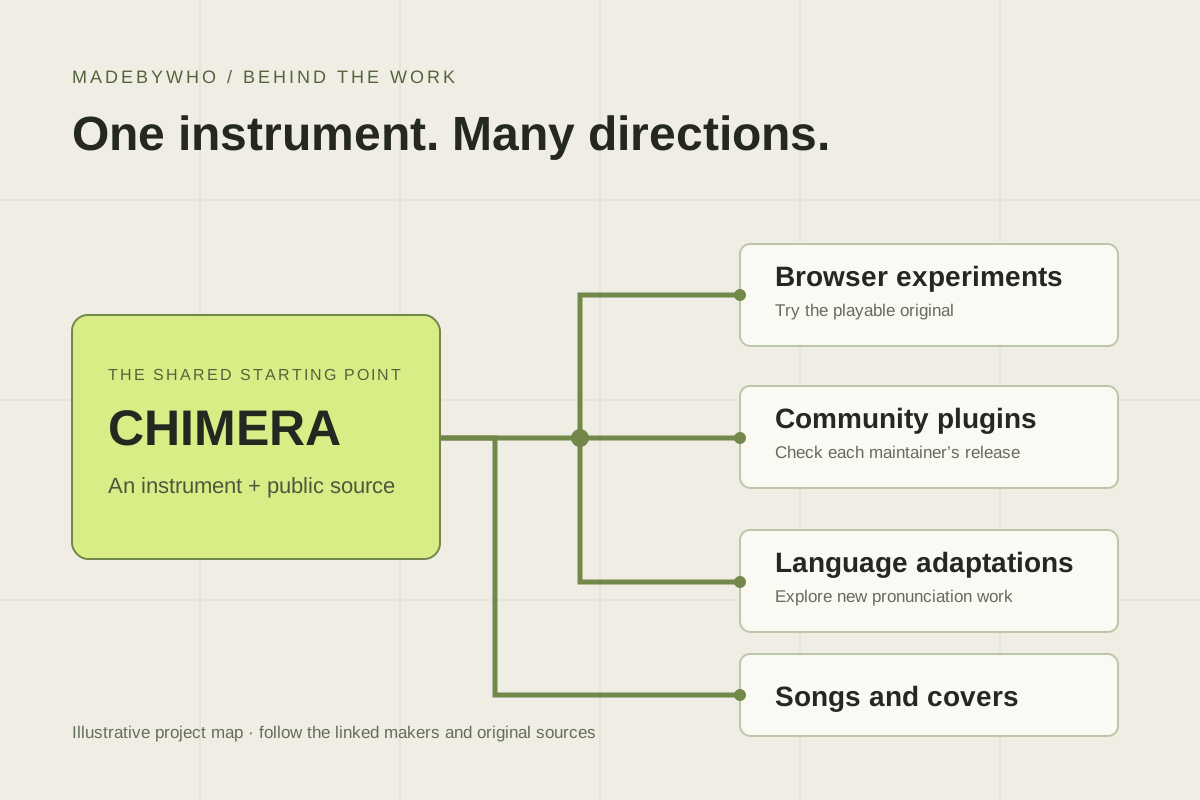
The public record already spans several kinds of making: source-code forks, a community VST3 adaptation, language work, musical covers and explainers. On November 11, 2026 at approximately 14:10 UTC, GitHub’s repository metadata showed 1,865 stars and 222 forks. Those are a dated snapshot of repository activity, rather than a count of active musicians or completed adaptations.
An instrument built from a simulated airway
The CHIMERA README describes physical-model voice synthesis: air, vocal folds and a branching tract generate the sound instead of a library of recorded voices. Its Rust engine runs in the browser through WebAssembly and an AudioWorklet.
The interface brings that mechanism into view. Move the tongue, lips and jaw in Play; type English or IPA in Speak; put lyrics on a piano roll in Sing; or use the Beatbox and Bestiary modes. The project’s MIT license allows others to study and adapt the code, subject to its terms and the separate licenses of bundled third-party material.
Our CHIMERA getting-started guide covers the browser controls, sound examples and local setup. Start there if you want to make a sound before exploring the source.
Code forks take different directions
A fork’s name alone does not establish that its promised feature works. For this selection, the descriptions below come from the maintainers’ own READMEs; they are not claims that we tested every build or device.
Chimera Lab credits Jameson and the upstream contributors for the synthesizer. It also distinguishes its distribution terms: the original engine is MIT-licensed, while the community plugin adapter is GPL-3.0-or-later. Check the exact project’s license before redistributing a build.
This is not a division between a browser-only official project and the only native plugin. The current upstream README also lists CLAP, VST3 and AU plugin support, while describing the web application as its primary surface. Community adaptations should be credited individually, with their own compatibility and release status.
- Chimera Lab, by Franzlazarus — An unofficial community VST3 instrument for Apple Silicon macOS. Its 0.4 alpha adds native performance controls and identifies remaining host and accessibility testing.
- chimera-pt-br, by hugoriosbrito — An experimental Brazilian Portuguese adaptation with a pronunciation front end and a partly translated interface.
- chimera-bagpipe-synth, by Denjin-K — A fork that applies physical synthesis to a bagpipe chanter and drones.
- chimera-neural, by parodyband — An experiment in which a learned policy operates the physical vocal tract through acoustic feedback; its README says the Rust engine still generates the samples.
Songs become demonstrations
The other branch of the story is musical. CupOJoseph’s Wonderwall post presents a cover and explains how pronunciations become timed gestures for lyrics. His repository is a GitHub fork of Jameson’s project.
Several linked YouTube examples identify the instrument in their titles:
These are links to the creators’ own uploads, not a claim that their recordings can be freely reused. Their titles and channel names were checked through YouTube’s public oEmbed metadata. We have not ranked the performances or treated view counts as proof of musical quality.
Jameson has shared a song too: Just You, posted on November 9 with vocals credited to CHIMERA. An original piece and a familiar cover answer different questions about the instrument: one shows what a maker wants to create, while the other gives listeners something they can compare with a tune they already know.
- The Longest Time — Haji84, credited in its title as CHIMERA vocal synth by Jameson Hodge.
- Still Alive — Micy.
- All I Want for Christmas Is You — ProbablePrime.
- I’m My Own Grandpa — Clare Midiviz, whose title identifies CHIMERA vocals.
The explanation and the visual language travel too
Jameson’s November 7 explanation discusses the branching acoustic model and his work tuning its output. Alex Hitt’s GitHub overview and Dazbii’s experiment with the synth give viewers other routes into the project.
The display itself is also part of the conversation. Game-tools developer Andrea Intg. posted about following CHIMERA’s visual lineage. That is commentary on a visual lineage, rather than evidence that every similar-looking instrument shares code.
These examples show several ways a project can circulate: as playable software, adaptable source, a performance and an explanation. They do not establish which factor caused its reach. The selection is a starting point for exploration, not a complete census of CHIMERA remixes.
Meet the maker beyond CHIMERA
Jameson’s GitHub profile links to jamesonhodge.com, and his public X author profile points to the same site. His repositories include other music tools and playful software:
Visit Jameson’s MadeByWho profile for his projects and dated public updates, or open the CHIMERA project page for the instrument, our video and sound samples.
- gbscore, a browser Game Boy music editor with WAV and GBDK C export.
- dotplan, a small AGENTS.md template and workflow for repositories used by coding agents.
- Broomsticks, his preservation and modernization port of Paul Rajlich’s original game.
- DeFidle, a daily DeFi quiz using DefiLlama data.
Try it and follow the sources
Play CHIMERA, read the source and license, then use our how-to guide to take the next step. For adaptations, start from the exact maintainer’s repository rather than assuming upstream instructions apply to every fork.
Facts were checked on November 11, 2026. Repository counts and project capabilities can change. Social dates record when posts were published, not when the software was created. MadeByWho is independent; inclusion does not imply endorsement by Jameson or the community makers. This story concerns Jameson Hodge’s vocal synth: the Hypno’s Lullaby song, ElevenLabs’ unrelated CHIMERA, and the Polyphia track are different works.
Sources
Source links were checked on November 11, 2026. Repository metrics are a dated snapshot; release status, licenses and availability belong to each linked project. Social dates show publication, not creation. Videos are linked to their original uploads.
- GitHub’s repository metadata
- CHIMERA README
- Chimera Lab, by Franzlazarus
- chimera-pt-br, by hugoriosbrito
- chimera-bagpipe-synth, by Denjin-K
- chimera-neural, by parodyband
- CupOJoseph’s Wonderwall post
- repository
- The Longest Time — Haji84
- Still Alive — Micy
- All I Want for Christmas Is You — ProbablePrime
- I’m My Own Grandpa — Clare Midiviz
- Just You
- Jameson’s November 7 explanation
- Alex Hitt’s GitHub overview
- Dazbii’s experiment with the synth
- Andrea Intg. posted about following CHIMERA’s visual lineage
- GitHub profile
- jamesonhodge.com
- gbscore
- dotplan
- Broomsticks
- DeFidle
- Play CHIMERA